B.Sc. Franziska Zeuner and Prof. Dr Thomas Zentgraf, from the ‘Ultrafast Nanophotonics’ research group in the Department of Physics at the University of Paderborn, together with M.Sc. Shumei Chen, Dr Guixin Li and Prof. Dr Shuang Zhang from the University of Birmingham, have succeeded for the first time in experimentally verifying so-called selection rules for non-linear optical processes involving circular polarisation states in mesoscopic structures. In doing so, Prof. Zentgraf’s research group investigated a non-linear optical process for generating the third harmonic from gold nanostructures, depending on their rotational symmetry. The results can be used to manufacture specialised spin-dependent plasmonic components that bridge the gap between ultra-fast – as they operate using light – and ultra-small, as today’s computer components must be.
In naturally occurring materials such as gold, the crystal structure and the associated electron distribution give rise to certain symmetries that dictate the directions in which electrons can oscillate, for example under the influence of an electromagnetic field. This cannot be altered in natural materials, but it can be in metamaterials. “With metamaterials, we create structures that are significantly larger than individual atoms, but still smaller than the wavelength of light. This enables us to create properties in materials that react to an electromagnetic field in a completely different way to how natural materials ever could,” explains Thomas Zentgraf: “This opens up new possibilities for the manufacture of components, for example in nanophotonics.”
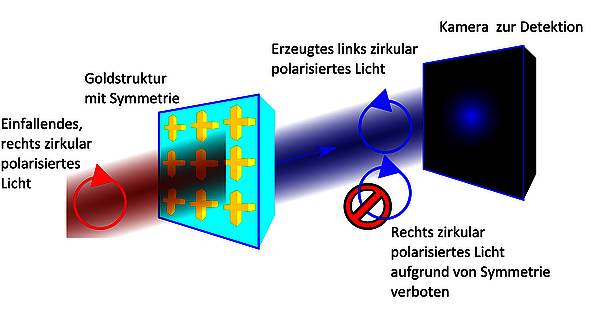
For the experiment, electron beam lithography was used to create various structures with different rotational symmetries from gold antennas 100 to 200 nm in length; for example, a ‘plus’ symbol – a structure that looks exactly the same as before after a 90°, 180°, 270° and 360° rotations. The antennas exhibit different rotational symmetries but have the same resonance frequencies at which the light interacts most strongly with the material. This is important because the conversion of the frequency of the incident light to the third harmonic depends on the extent to which the material can be polarised by the light. The selection rules are intended to demonstrate that, although the structures interact with the external light field, no third harmonic of a specific polarisation is generated solely on the basis of symmetry. “You can understand the resonance frequency of a system, for example, by thinking of the process of swinging,” explains Franziska Zeuner: “The swing symbolises the electron, and the initial push symbolises the electromagnetic field. The frequency of the push at which you swing as high and as fast as possible corresponds to the resonance frequency.”
Whilst the researchers in Birmingham examined the samples using a camera of the kind found in any digital camera or mobile phone and were able to verify the theoretical predictions via the observed light intensity, the physicists in Paderborn also used a spectrometer that measures the amount of light at a specific wavelength. “The selection rules are used to formulate expectations, such as: ‘For a particular order – in this case, the third order – and for a structure with a certain symmetry, I expect either a light signal or no light signal’,” says Franziska Zeuner.
For the experimental investigations, infrared laser light is tuned to the resonance frequency of the metamaterial. Using a combination of waveplates and linear polarisers, right-circularly polarised light is generated and focused onto the sample. The electrons in the gold nano-antennas are excited by the electromagnetic field of the laser light, begin to oscillate and re-emit the incident light either with the same polarisation, the orthogonal polarisation, or both. However, the wavelength detected is approximately 400 nm, which is one-third of the original infrared wavelength of the incident light. In the case of a structure with fourfold rotational symmetry that was irradiated with circularly polarised light, only the orthogonal polarisation could ever be observed, and never the same polarisation state. This behaviour is also known to occur in natural materials, but it has been demonstrated for the first time in artificially produced metamaterials, whose symmetry properties can be specifically tuned during manufacture.