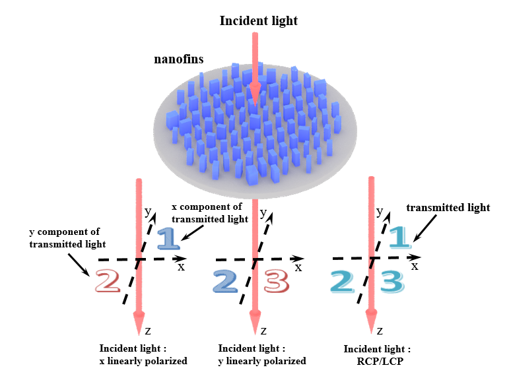
Encrypted communication through the manipulation of light: the latest findings in the field of photonics research are set to make this possible in the near future. In order to specifically alter optical properties – that is, the propagation and transmission of light – so-called meta-surfaces are set to be used in future. These are artificial structures that can influence the properties of light waves. However, these materials have not yet been sufficiently researched for industrial and efficient use. To change this, scientists at Paderborn University and the Beijing Institute of Technology, China, are now investigating, as part of a joint research project, how their efficiency can be improved. Furthermore, the physicists aim to develop surfaces with nanostructures capable of manipulating several properties of light simultaneously. The German Research Foundation (DFG) and the National Science Foundation of China (NSFC) are funding the project, which is initially scheduled to run for three years, with around 500,000 euros.
Light as a carrier of information
“In order to make data transmitted via light secure against eavesdropping and to encode it within the context of quantum communication, the properties of the light used must be manipulated. To achieve this, traditional optical components are often used in conjunction with optoelectronic beam shapers, which rely on the interaction of light with matter – similar to a modern chip in digital cameras. However, these components are not only expensive but also large,” explains project leader Prof. Dr Thomas Zentgraf from the Department of Physics.
So-called metamaterials, whose surfaces consist, for example, of nanoscopic structures, already enable this manipulation in very thin layers. “They consist of artificially created structures whose optical, magnetic or electrical properties do not occur in nature. Their advantage is that they can refract and even alter radiation,” says Zentgraf.
Nanostructuring to influence non-linear properties
Through the use of modern nanotechnology, materials can be structured almost down to the atomic level. This, in turn, turns them into synthetic metamaterials with which light beams can be shaped within the smallest of spaces or frequencies converted. With the help of nanostructuring, it is now possible to specifically influence even non-linear properties, something that was previously hardly possible using traditional approaches. Zentgraf comments: “Non-linear effects occur when outer electrons begin to oscillate intensely. This allows new frequencies to be achieved, without which targeted manipulation would not be possible.”
To enhance the functionality of optical metasurfaces, the scientists are now investigating the problem of simultaneously modifying several beam parameters. This refers, for example, to changes in the polarisation (direction of oscillation), phase (state of oscillation) or amplitude (magnitude of oscillation) of a wave. These parameters, which can be used for information encoding and transmission, determine the efficiency of metamaterials.
The physicists led by Zentgraf are planning both theoretical and experimental investigations. Across a total of four sub-areas, the focus is, amongst other things, on new fundamental design methods, such as deep learning using neural networks for faster design, multifunctionality, and the active control of linear and non-linear optical effects.