
Cleanroom and fabrication
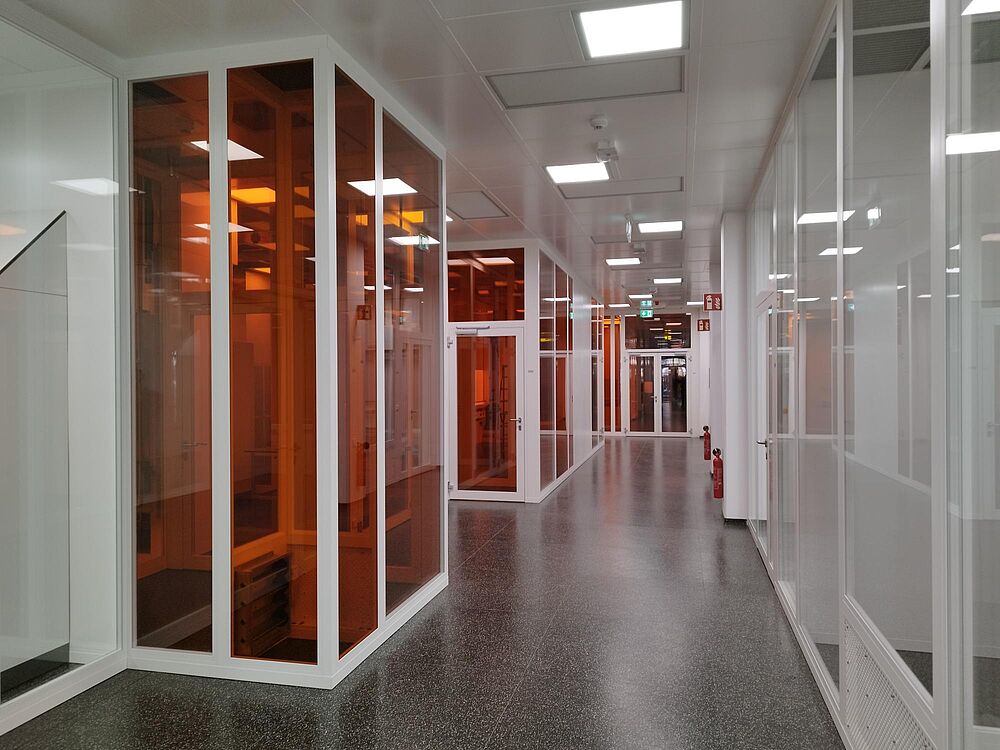
We have access to modern clean room facilities (ISO5/6) in building P10 (PhoQS-Lab) for the production of integrated optical chips. The technical equipment enables the production of integrated optical circuits both in thin-film lithium niobate and in lithium niobate bulk crystals. Various lithography processes, e.g. mask lithography, laser beam lithography or electron beam lithography, wet-chemical and dry etching processes for waveguide production, coating processes and extensive methods for characterising the chips produced can be used.
Further information on the technical equipment can also be found on the PhoQS website.
Optical laboratories
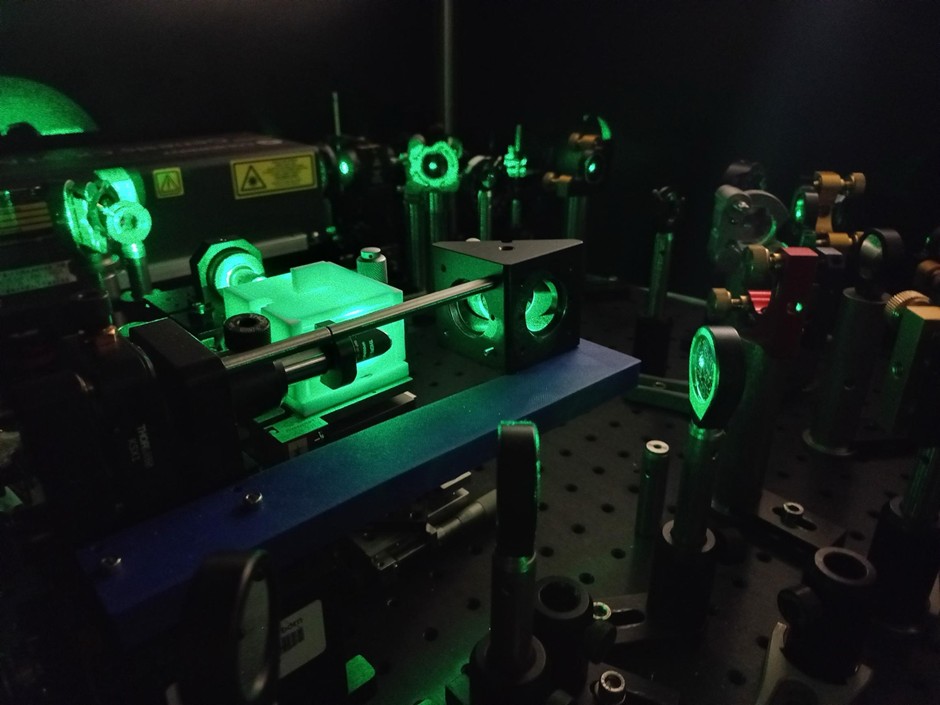
We have several fully equipped characterization and quantum optics laboratories with temperature stability of better than half a degree. They are equipped with actively stabilized optical tables, and the general infrastructure includes single photon detectors (both APDs and SNSPDs), single-photon sensitive spectrometers, fast time taggers, optical spectrum analyzers, optical pulse shapers, and fast electronics. Several labs are equipped with acoustically isolated rooms that house noisy equipment such as compressors.
Laser sources
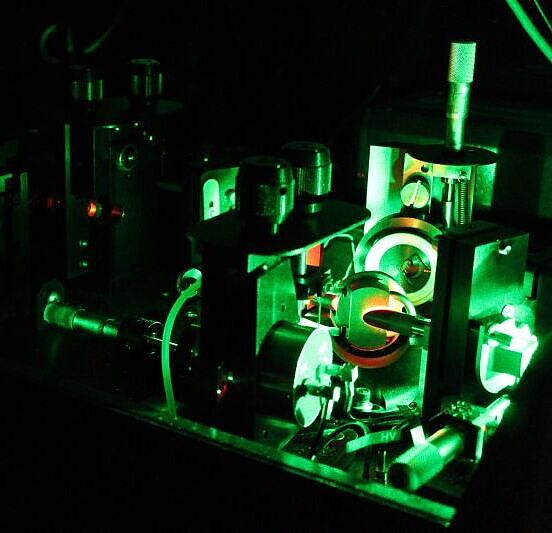
The group owns numerous laser systems that cover wavelengths from the blue to the mid-infrared. Operation modes include continuous wave and picosecond/femtosecond pulsed with pulse repetition rates from single shot up to several Gigahertz. While modelocked laser systems are located in dedicated labs, many diode lasers are portable and shared between projects.
Single photon detectors
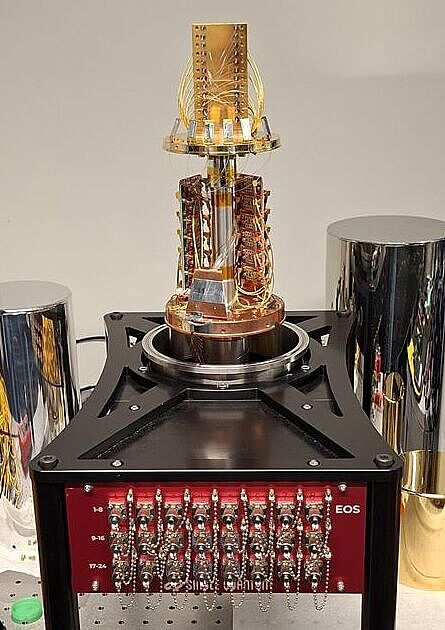
We have a large number of state-of-the-art single photon detectors for carrying out quantum optical experiments. These enable us to realise ground-breaking experiments, such as the first photonic quantum computer in Germany. For the characterisation of large and complex quantum states, we not only rely on the large number of detectors available to us, but also actively develop methods for counting photons [1]. Together with the other areas of the group, this provides a constant drive for innovation between the advancement of quantum state detection and the advancement of our integrated photonic sources to advance our combined quantum state detection and generation capabilities.
[1] T. Schapeler, et al, Electrical trace analysis of superconducting nanowire photon-number-resolving detectors, Phys. Rev. Applied 22, 014024 (2024)