Photonic Quantum Computing
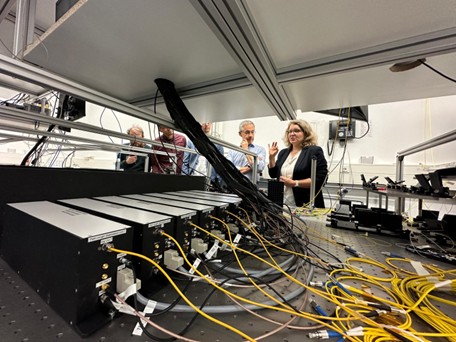
In the Photonic Quantum Computing group, we investigate experimental architectures for the realisation of quantum computers and simulators in the field of Noisy Intermediate-Scale Quantum (NISQ) technology and explore use cases for these systems. Our research is implemented in complex optical networks that utilise integrated components and state-of-the-art technologies.
The Paderborn Quantum Sampler (PaQS)
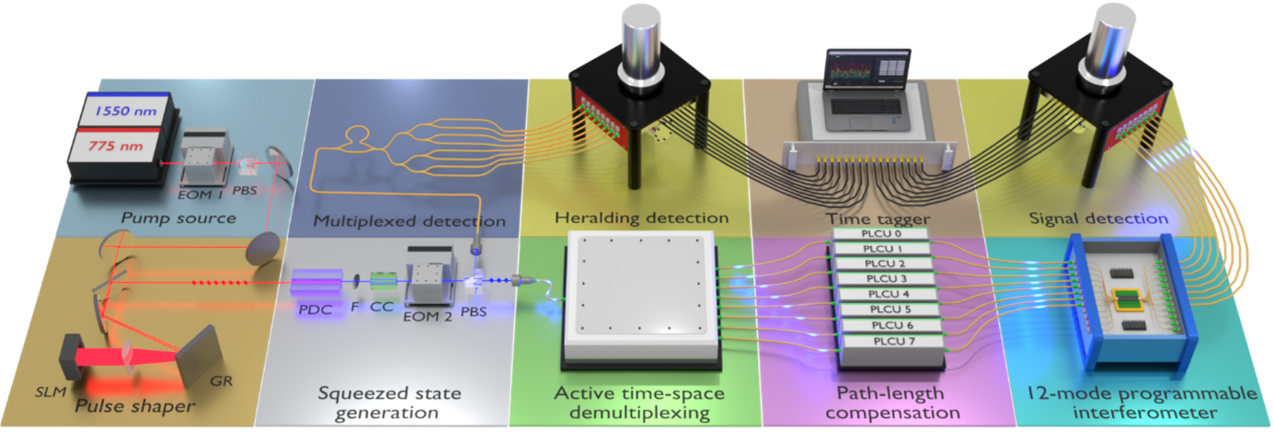
A schematic representation of the Paderborn Quantum Sampling (PaQS) system - Europe's largest boson sampling machine [1]. The figure illustrates the numerous subsystems, many of which are integrated and must be combined in order to realise a fully functional device. This platform is used in a variety of investigations, for example to research possible applications and to benchmark different configurations.
Applications
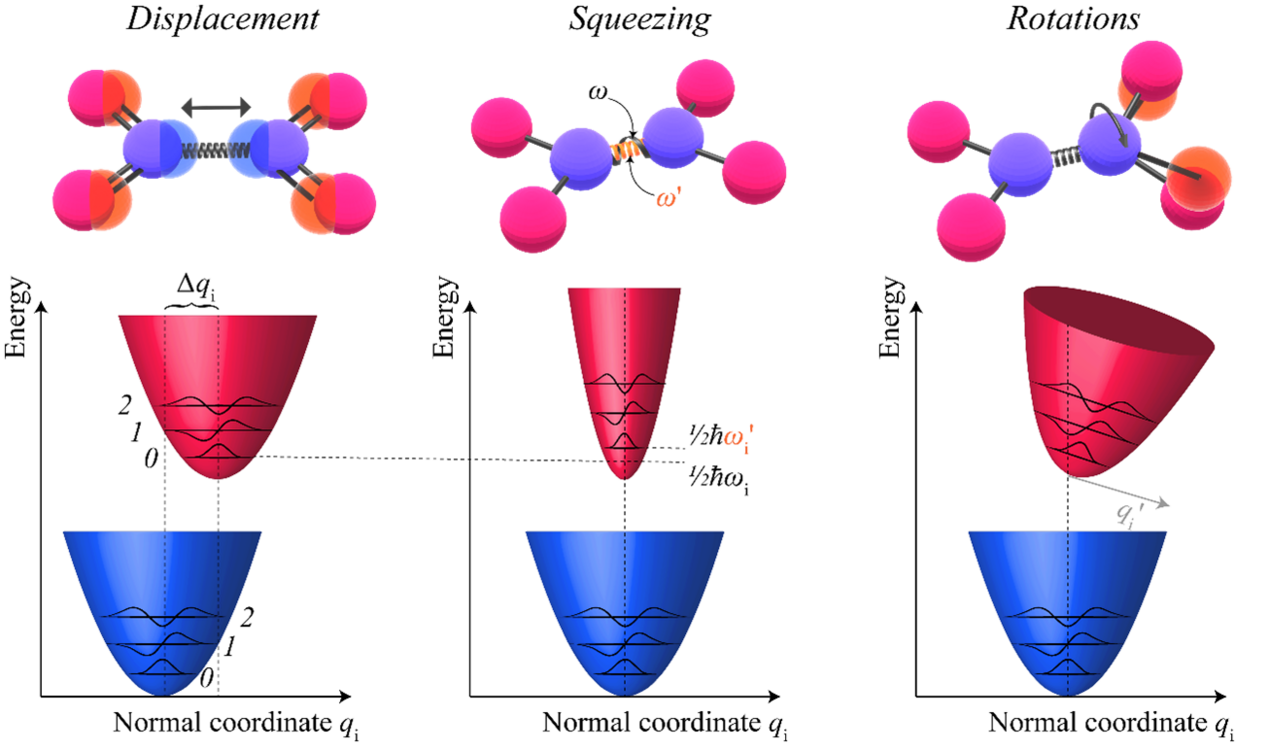
Quantum computers promise to solve many problems that are unsolvable for classical computers. We investigate possible applications - for example in the calculation of molecular vibronic spectra [2] - and show how these problems can be mapped onto available architectures.
Alternative approaches
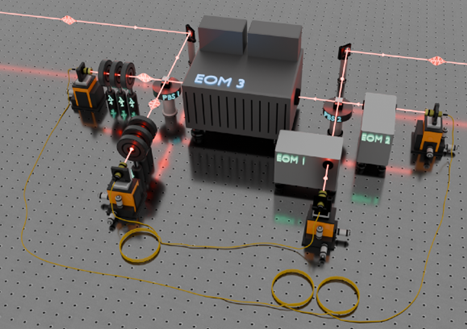
Optical networks can be realised in many different ways. This figure shows how a programmable network in the time domain can be implemented using fibre loops and electro-optical switches. This implementation offers many unique advantages, such as high resource efficiency [3].
Further reading
[1] M. Stefszky, et al, Benchmarking Gaussian and non-Gaussian input states with a hybrid sampling platform. (2025) arXiv. https://arxiv.org/abs/2512.08433
[2] J.-L. Eickmann, et al, Is the Full Power of Gaussian Boson Sampling Required for Simulating Vibronic Spectra Using Photonics? (2025). arXiv. arxiv. org/abs/2507.19442
[3] J. Lammers, et al, Resource-efficient universal photonic processor based on time-multiplexed hybrid architectures. (2025) arXiv https://arxiv.org/abs/2509.22521
Recent publications from the Photonic Quantum Computing group
Practical considerations for assignment of photon numbers with SNSPDs
T. Schapeler, I. Mischke, F. Schlue, M. Stefszky, B. Brecht, C. Silberhorn, T. Bartley, APL Quantum 3 (2026).
Bridging chemistry and Gaussian boson sampling: a photonic hierarchy of approximations for molecular vibronic spectra
J.-L. Eickmann, K.-H. Luo, M. Roiz, J. Lammers, S. Atzeni, C. Pandey, F. Lütkewitte, R.G. Shirazi, F. Schlue, B. Brecht, V.V. Rybkin, M. Stefszky, C. Silberhorn, Npj Quantum Information 12 (2026).
Photorefraction management in lithium niobate waveguides: High-temperature vs cryogenic solutions
N.A. Lange, R. Pollmann, M. Rüsing, M. Stefszky, M. Protte, R. Ricken, L. Padberg, C. Eigner, T. Bartley, C. Silberhorn, Journal of Applied Physics 139 (2026).
Spectral and temporal properties of type-II parametric down-conversion: The impact of losses during state generation
D.A. Kopylov, M. Stefszky, T. Meier, C. Silberhorn, P.R. Sharapova, Physical Review Research 7 (2025).
Photorefraction and in-situ optical cleaning in various types of LiNbO3 waveguides
M. Kirsch, C. Kießler, S. Lengeling, M. Stefszky, C. Eigner, H. Herrmann, C. Silberhorn, Optics & Laser Technology 193 (2025).
Show all publications