
Quantum Technology
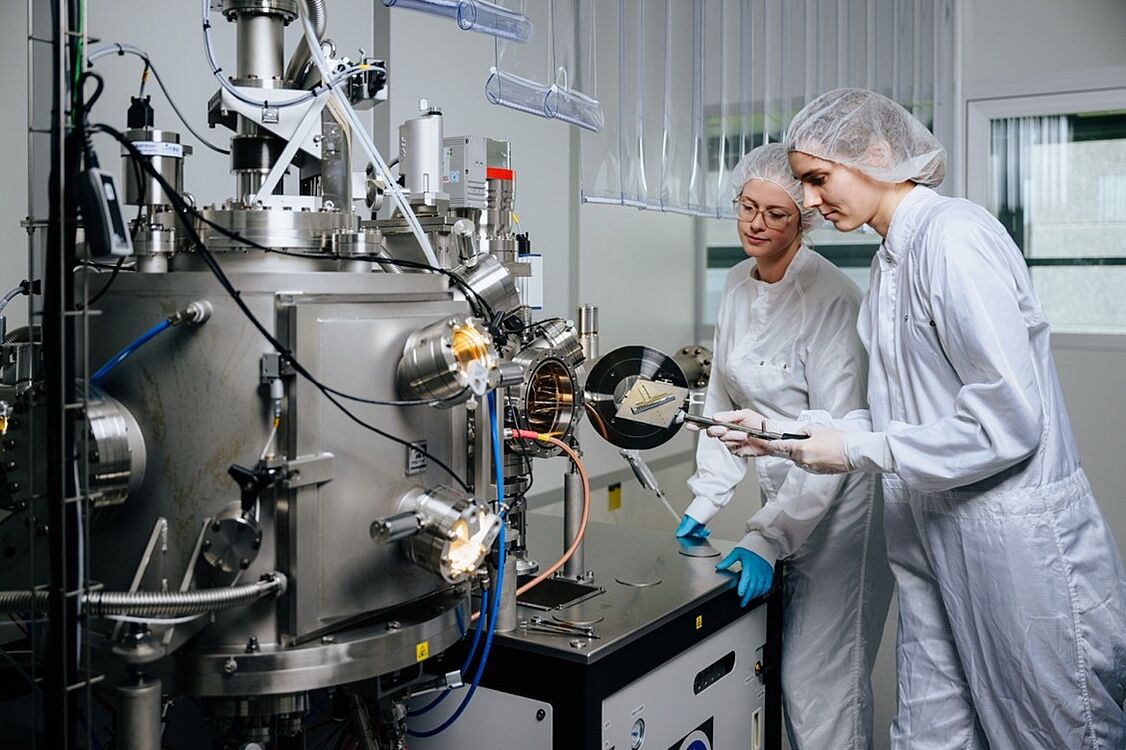
In the Quantum Technology group, we are developing the foundations for a new generation of compact, powerful and scalable photonic devices that will shape the future of quantum and classical photonic systems. Our focus is on integrated photonics in lithium niobate, in particular thin-film lithium niobate (TFLN) and traditional titanium-diffused waveguides.
We are building a modular toolbox of high-precision components that serve as building blocks for complex devices integrated on chips. These include TFLN waveguides with customised optical properties, periodically-poled TFLN structures for non-linear processes such as frequency doubling and parametric down conversion (PDC), and electro-optic modulators with high bandwidth and low switching voltages.
By combining materials Science, micro- and nanofabrication and optical system integration, we work at the interface between basic research and technological implementation - with the aim of making quantum and photonic systems more efficient, smaller and more usable.
Waveguides in thin-film lithium niobate (TFLN)

We develop and characterise high-quality TFLN waveguides that enable extremely low optical attenuation and excellent mode guidance thanks to an optimised material structure and precise geometry [1]. They are manufactured in a clean room environment using electron beam lithography and dry chemical etching, which ensures high reproducibility and minimal surface roughness. These properties are crucial for the realisation of quantum optical interference and stable, scalable devices.
Periodic poling in TFLN
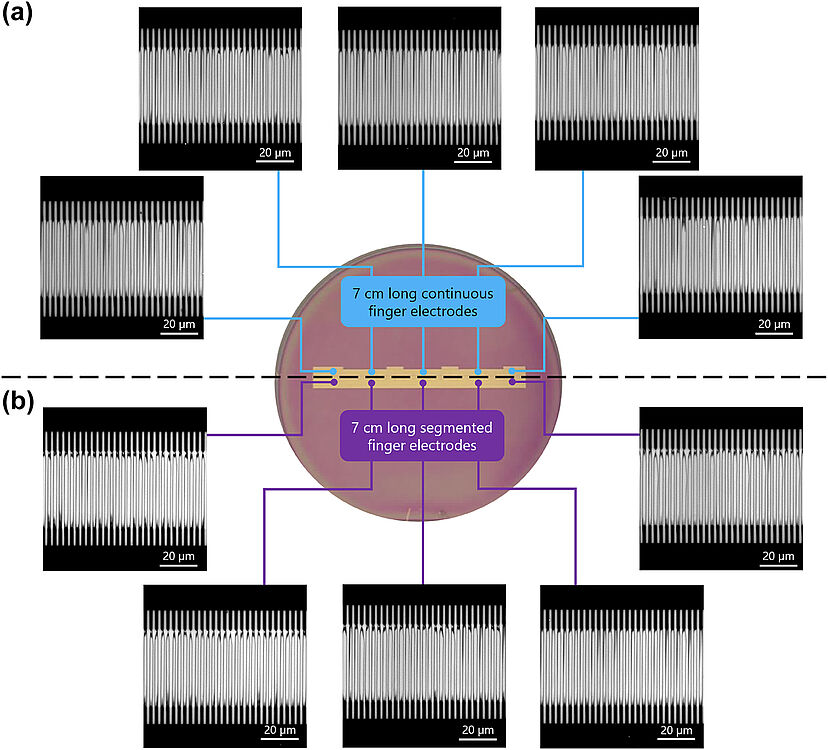
Periodic poling is the basic requirement for efficient, non-linear processes in TFLN components. We realise homogeneous, continuous periodic poling over large wafer areas to enable efficient and high-purity single-photon sources as well as non-linear processes such as parametric amplification and frequency conversion. By developing innovative segmented finger electrodes, we optimise the poling accuracy and homogeneity [2], which significantly improves the stability and performance of quantum light sources.
Electro-optical modulators in TFLN

Our TFLN-based electro-optic modulators enable the fast and energy-efficient manipulation of light signals, crucial for the control of quantum light states, the generation of temporally encoded qubits and integration into dynamic optical circuits. Due to the high electro-optical coefficients of lithium niobate and miniaturisation in TFLN structures, we achieve modulation rates in the GHz bandwidth with low power consumption and low voltages.
Traditional titanium-diffused waveguides in lithium niobate
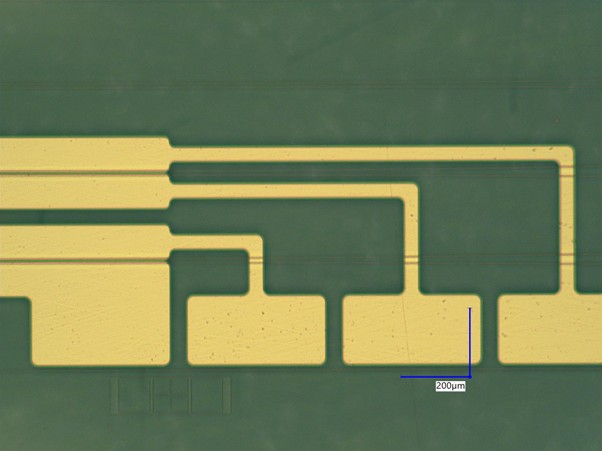
We draw on over 40 years of experience in the development and optimisation of titanium-diffused waveguides, which are now regarded as an absolutely mature and highly reliable technology. These waveguides offer excellent optical properties, extremely low optical losses, are ideal for the generation of entangled photon pairs and the implementation of complex quantum optical circuits. Their high stability and reproducibility make them an established building block in quantum photonics.
Further reading
[1] S. Babel, et al, "Demonstration of Hong-Ou-Mandel interference in an LNOI directional coupler" Optics Express 31, 23140 (2023); DOI: 10.1364/OE.484126
[2] L. Bollmers, et al, Segmented finger electrodes to optimise ultra-long continuous wafer-scale periodic poling in thin-film lithium niobate, Nanophotonics 14, 4761 (2025); DOI: 10.1515/nanoph-2025-0461
[3] K.-H. Luo, et al. Counter-propagating photon pair generation in a nonlinear waveguide, Optics Express 28, 3215 (2020); DOI: 10.1364/OE.378789
Recenet publications from the Quantum Technology group
High-performance photon-pair source using a two-photon-polymerized strip-loaded lithium niobate waveguide
M.A. Sewidan, A. Rittmeier, L. Bollmers, S. Babel, E. Chatzizyrli, J.S.S. Duran Gomez, L. Padberg, C. Eigner, C. Silberhorn, D. Bremner, A. Wienke, D. Kracht, M. Hinkelmann, M. Kues, Optics Express 34 (2026).
Photorefraction management in lithium niobate waveguides: High-temperature vs cryogenic solutions
N.A. Lange, R. Pollmann, M. Rüsing, M. Stefszky, M. Protte, R. Ricken, L. Padberg, C. Eigner, T. Bartley, C. Silberhorn, Journal of Applied Physics 139 (2026).
Ultrabright, two-color photon pair source based on thin-film lithium niobate for bridging visible and telecom wavelengths
S. Babel, L. Bollmers, F. Roeder, W. Ridder, C. Golla, R. Köthemann, B. Reineke, H. Herrmann, B. Brecht, C. Eigner, L. Padberg, C. Silberhorn, Optics Express 33 (2025).
Segmented finger electrodes to optimize ultra-long continuous wafer-scale periodic poling in thin-film lithium niobate
L. Bollmers, N. Spiegelberg, M. Rüsing, C. Eigner, L. Padberg, C. Silberhorn, Nanophotonics 14 (2025) 4761.
Second-order nonlinear piezo-optic properties of single crystal lithium niobate thin films
M.N. Pionteck, M. Roeper, B. Koppitz, S.D. Seddon, M. Rüsing, L. Padberg, C. Eigner, C. Silberhorn, S. Sanna, L.M. Eng, Physical Review B 111 (2025).
Show all publications