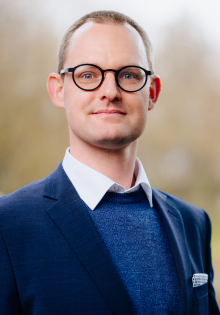
"Ultrafast Quantum Photonics" group
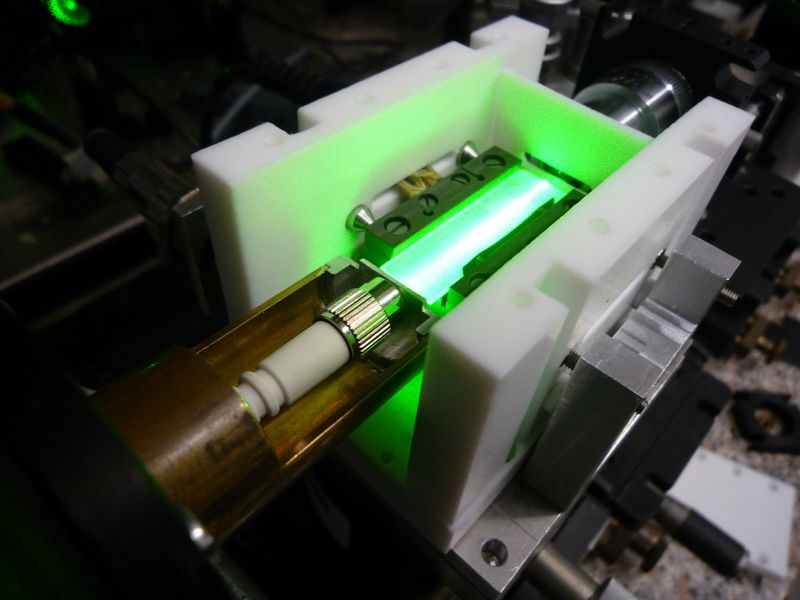
The “Ultrafast Quantum Photonics” group works on quantum technologies based on quantum light pulses [1], for example the precise analysis of matter (quantum spectroscopy), high-precision measurement techniques (quantum metrology), and frequency-based quantum networks.
The quantum light pulses are generated and processed in tiny waveguides integrated on chips [2]. A key component is our quantum pulse gate, which enables us to selectively control, route, and measure light pulses with complex spectra. Our work lies between fundamental research and practical application – with the goal of making quantum technologies simpler, smaller, and more practical to use.
Quantum Pulse Gate
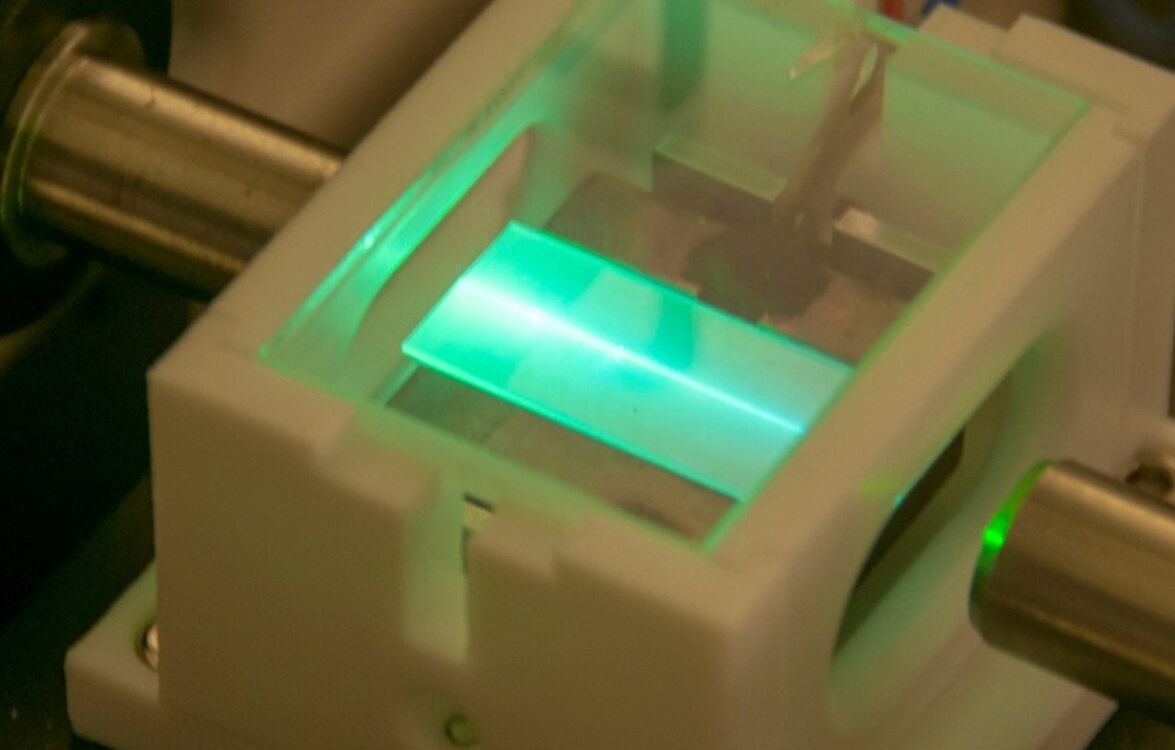
The quantum pulse gate (QPG) is based on dispersion-engineered sum-frequency generation in a waveguide. A quantum light signal and a bright laser pulse propagate through the waveguide at the same group velocity. By shaping the complex spectrum of the laser pulse, we determine which part of the quantum light is converted.
This allows us to explore a broad range of applications. Examples include the characterization of quantum light pulses (FIREFLY) [3], multi-channel detectors (multi-output QPG) [4], and super-resolved time and frequency measurements [5]. We continuously work to expand the range of applications of our QPGs and to make our components smaller and more efficient.
Quantum Spectroscopy
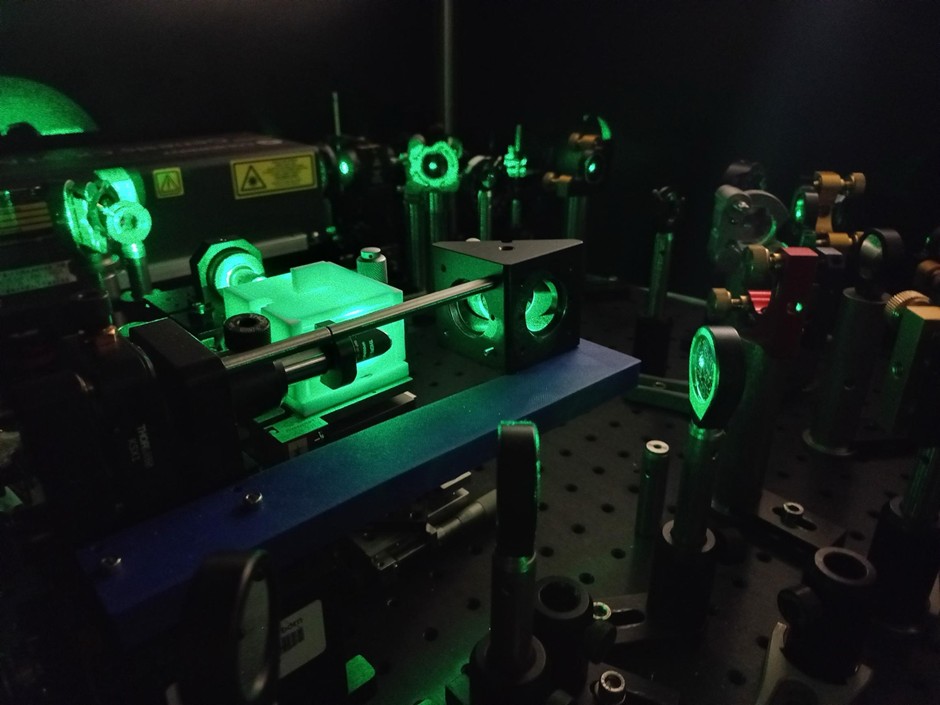
Spectroscopy is a widely used method for investigating a wide variety of samples, with applications in environmental monitoring and medical diagnostics. When combined with the peculiar properties of quantum light, it becomes possible to build sensors that probe a sample at one wavelength, for example in the mid-infrared, while reading out the information at another wavelength, for example in the visible [6].
This approach opens up new fields of application, enables the miniaturization and cost reduction of sensors, and improves measurement accuracy.
Quantum Communication
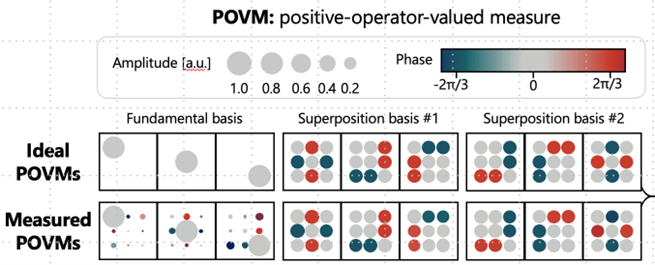
We investigate high-dimensional quantum communication using frequency encoding. On the one hand, this means that we encode information not in bits (0 or 1) but in so-called dits (0, 1, …, d–1); each photon thus carries more information and encryption becomes more secure. On the other hand, it means that we use different frequencies as “letters.” This requires us to measure superpositions of these frequencies. For this purpose, we use the multi-output QPG described above.
Our approach is attractive because it uses the same technologies that also enable the internet. It can furthermore be combined with other approaches and therefore offers enormous scaling potential.
Quantum Networks
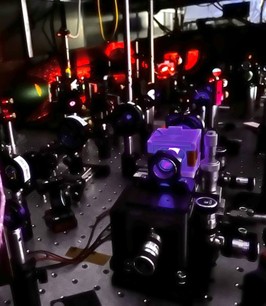
Our research on quantum networks combines results from the other areas: quantum light sources with extreme time-frequency entanglement; the routing of frequencies in QPGs [7]; and finally, counting and correlating photons at the individual outputs.
This toolbox enables highly efficient programmable quantum networks [8]. We require only two waveguides and can operate at high clock rates. Our approach can play a central role in the development of scalable quantum networks for quantum simulation and quantum computing.
Further reading
[1] B. Brecht et al, "Photon Temporal Modes: A Complete Framework for Quantum Information Science", Phys. Rev. X 5, 041017 (2015); DOI: https://doi.org/10.1103/physrevx.5.041017
[2] V. Ansari et al, "Tailoring nonlinear processes for quantum optics with pulsed temporal-mode encodings", Optica 5, 534-550 (2018); DOI: https://doi.org/10.1364/optica.5.000534
[3] A. Bhattacharjee et al, "Frequency-bin interferometry for reconstructing electric fields with low intensity", arXiv:2504.08607 (2025); DOI: https://doi.org/10.48550/arXiv.2504.08607
[4] L. Serino et al, "Realisation of a Multi-Output Quantum Pulse Gate for Decoding High-Dimensional Temporal Modes of Single-Photon States", PRX Quantum 4, 020306 (2023); DOI: https://doi.org/10.1103/prxquantum.4.020306
[5] V. Ansari et al, "Achieving the Ultimate Quantum Timing Resolution", PRX Quantum 2, 010301 (2021); DOI: https://doi.org/10.1103/prxquantum.2.010301
[6] F. Roeder et al, "Toward integrated sensors for optimised opticla coherence tomography with undetected photons", Phys. Rev. Applied 25, 034031 (2026); DOI: https://doi.org/10.1103/cwsx-42c4
[7] S. De et al, "Realisation of high-fidelity unitary operations on up to 64 frequency bins", Phys. Rev. Research 6, L022040 (2024); DOI: https://doi.org/10.1103/physrevresearch.6.l022040
[8] P. Folge et al, "A Framework for Fully Programmable Frequency-Encoded Quantum Networks Harnessing Multi-Output Quantum Pulse Gates", PRX Quantum 5, 040329 (2024); DOI: https://doi.org/10.1103/prxquantum.5.040329