A research team at Paderborn University is investigating how photorefractive interference in lithium niobate waveguides can be better controlled. Such waveguides are important building blocks for integrated optical and quantum optical systems, for example for frequency conversion or the generation of individual photons.
Photorefractive effects occur when light causes local changes to the refractive index in the material. This can impair the efficiency and spectral properties of optical components. This is particularly problematic at high optical powers or at cryogenic temperatures, as required for certain quantum technologies.
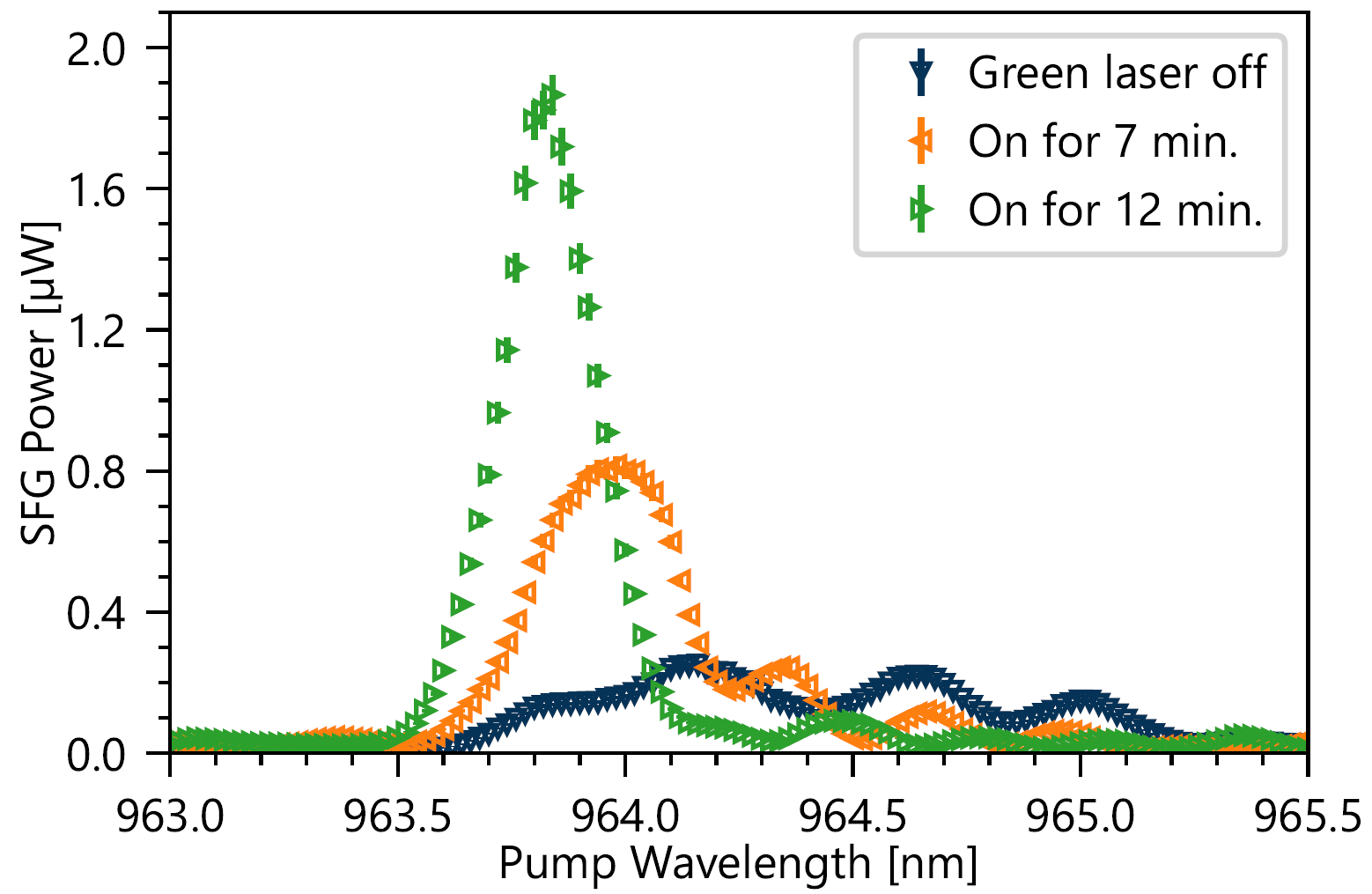
In the study, the researchers compared two approaches: operation at elevated temperatures and operation at very low temperatures of around 7 Kelvin. While high temperatures can effectively suppress photorefractive damage, this solution is not suitable for cryogenic applications. Therefore, the team additionally tested a green auxiliary laser coupled into the waveguide.
The results show that this additional green light can partially mobilise frozen charges in the material and thus improve the optical function of the waveguide. The work thus offers a promising approach for operating lithium niobate components more stably even under cryogenic conditions.
The study brings integrated quantum technologies one step closer to robust applications in complex environments, for example in cryogenic systems or with limited energy budgets. The paper is available here: https://doi.org/10.1063/5.0324002
The project was supported by the German Research Foundation (DFG) under grant no. 231447078 - TRR 142.