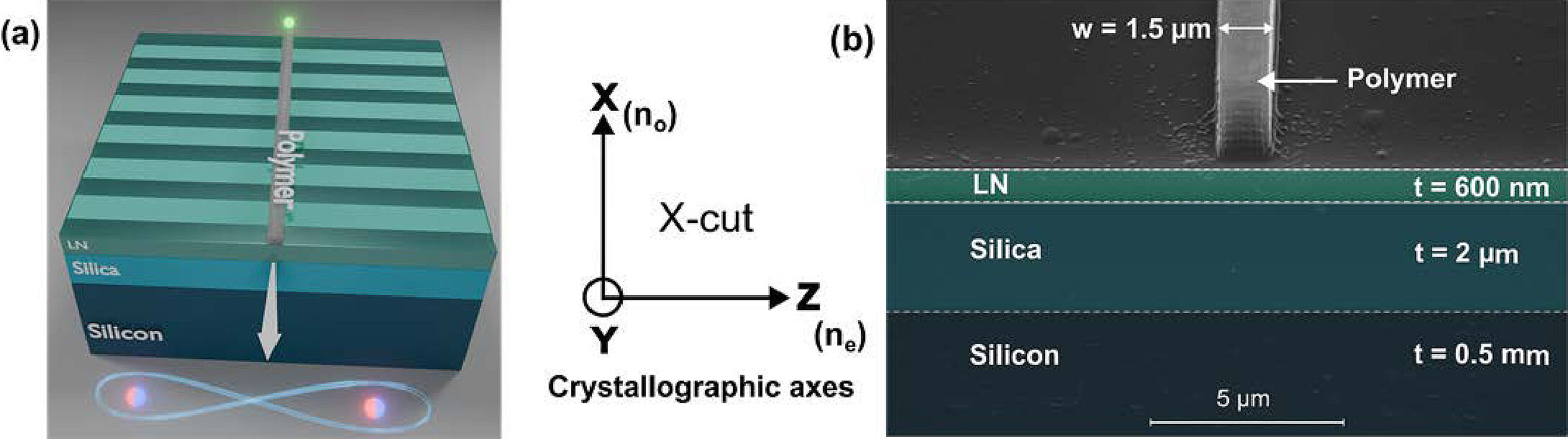
In a new publication, researchers from the Integrated Quantum Optics group, led by Christine Silberhorn, and researchers from the Laser Centre Hannover demonstrate how rewritable and freely reconfigurable light sources for quantum light can be produced using 3D nanoprinting.
Quantum photonics utilises individual particles of light, known as photons, for new technologies in communications, sensor technology and data processing. A key prerequisite for this is compact, reliable sources that generate pairs of correlated photons. If such sources are integrated directly onto optical chips, photonic quantum systems could become smaller, more robust and more scalable in future.
Until now, the optical fibre structures required for this have generally been fabricated using complex etching processes. These manufacturing processes involve long development times and consume significant amounts of materials and resources, particularly when errors occur or the properties of a structure need to be adjusted retrospectively.
In a collaboration between the Silberhorn research group at the Institute for Photonic Quantum Systems (PhoQS) at Paderborn University, Leibniz University Hannover and the Laser Centre Hannover, a flexible alternative has now been demonstrated: A high-precision 3D printing process, known as two-photon polymerisation, creates the optical fibre structures directly on a chip made of thin lithium niobate.
The waveguides produced in this way guide laser light in a way that specifically generates photon pairs. The integrated source achieves high generation rates whilst maintaining the high quality of the generated pairs. Particularly noteworthy is the reusability of the approach: the printed waveguides could be removed from the lithium niobate substrate and subsequently reprinted. The re-fabricated structures achieved comparable performance.
The results demonstrate the potential of 3D printing for photonic quantum chips. Instead of having to completely discard chips due to minor manufacturing defects, optical components could in future be selectively replaced, adjusted or remanufactured. This can shorten development cycles, save resources and advance the scalable production of high-performance quantum technologies.
The work was supported by various funding bodies and partners, including the German Research Foundation (DFG), the Federal Ministry of Research, Technology and Space (BmFTR) and TÜV Nord/Alter Technology.
The paper is freely available to everyone and can be read via the following link: doi.org/10.1364/OE.596879