In our latest publication, Michelle Kirsch and co-authors show how negative effects influence optical frequency conversion processes in integrated optical circuits and how these can be reduced.
In integrated optics, nonlinear optical crystals are used to convert light of different frequencies into each other. These processes play a central role in quantum computers, novel spectroscopy and improved measurement technology. One crystal that has non-linear optical properties is lithium niobate. Lithium niobate is being researched in Paderborn and around the world, as it exhibits particularly strong non-linear optical properties.
However, a known problem with the material is that the so-called photorefractive effect occurs at high light intensities, which changes the optical properties of the material and can even damage them. This effect is chaotic and difficult to predict and describe.
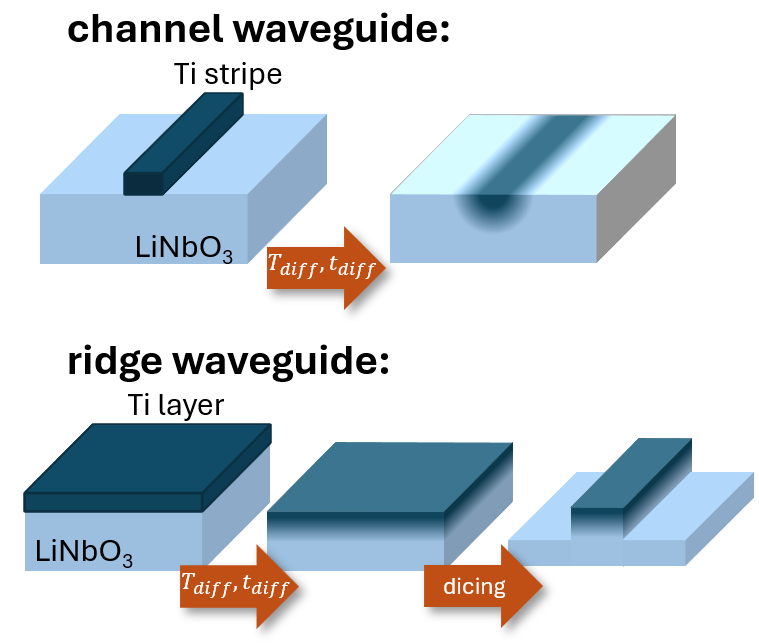
In our article, we present our research results on the investigation of the photorefractive effect on sum frequency generation, in which we compare two optical waveguide geometries in terms of susceptibility to damage. In addition, we show a new method how this effect can be reduced and cured in-situ with light.
This work was funded by the German Federal Ministry of Research, Technology and Space (BMFTR) as part of the QR.X research project.