Scientists at the University of Paderborn develop new technology for manipulating light. The research results are now published in the journal Nature Photonics.
Congratulations to Dr. Bernhard Reineke-Matsudo. After a successful disputation of his thesis on nonlinear holography with Metamaterials, Mr. Reineke-Matsudo will proceed as Postdoc at the Institute for Photonic Quantum Systems at Paderborn University. We are looking forward for a fruitful collaboration with him.
Congratulations to Dr. Jinlong Lu. After a successful disputation of his thesis on Topological Photonics with Metamaterials, Mr. Lu will leave us. We wish him every success in his further life and career.
Congratulations to Dr. Daniel Frese. After a successful disputation of his thesis on Holography with Metamaterials, Mr. Frese will leave us. We wish him every success in his further life and career.
The presidium of Paderborn University has announced his decision to appoint the physicist and acting speaker of the Center for Optoelectronics & Photonics Paderborn (CeOPP), Prof. Dr. Thomas Zentgraf, as scientific advisory board member for the L-LAB. The L-LAB (www.l-lab.de) is a non-university research institute for lighting technology and mechatronics supported by the Paderborn University, Hamm-Lippstadt University of Applied Sciences and…
Congratulations to Dr. Florian Spreyer. After a successful disputation of his thesis on Hybrid Metamaterials, Mr. Spreyer will leave us. We wish him every success in his further life and career.
When light hits a pinhole with a hole diameter below the wavelength as a plane wave, spherical waves can form behind the pinhole. If now a whole ensemble of holes with well-considered positioning is chosen, the different spherical waves can interfere with each other in any way. The superposition of the transmitted individual waves then results in a new wave front which can, for example, carry image information. Such a construct is called a photon…
Scientists at Paderborn University have now demonstrated, for the very first time, the spatial confinement of a light wave to a point smaller than the wavelength in a ‘topological photonic crystal’.
Who doesn't know the laser sword from the Star Wars movies? But what are lasers and how do they work? What else can you do with them? These were the questions the students of the MINT-EC-Camp: Laser Physics explored during their visit to the Department of Physics.
Photo (Jamie Kidston, ANU): With a Marie Skłodowska Curie Fellowship from the EU, Dr. Sergey Kruk from the Australian National University is conducting research at the University of Paderborn in the field of nonlinear nano-optics.
Professor Thomas Zentgraf from the Physics Department has now been selected as the second Paderborn physicist as a new Fellow of the Max Planck School for Photonics.
Congratulations to Dr. Christian Schlickriede. After a successful disputation of his thesis on Nonlinear Metalenses, Mr. Schlickriede will leave us. We wish him every success in his further life and career.
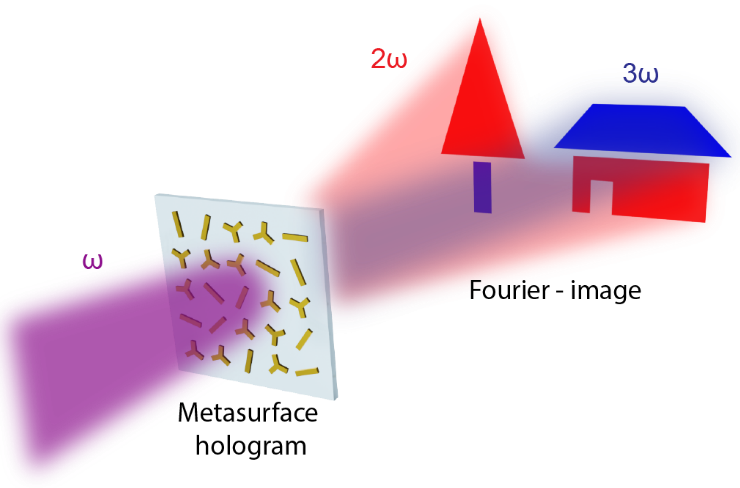
Nonlinear plasmonic metasurface for color holography. Rotation symmetric gold nano antennas are used to encode a holographic image based on the Pancharatnam–Berry phase. The position of the meta-atoms can be randomly distributed in a square lattice, while the rotation of each antenna is significant for the image encryption. The schematic illustration shows a nonlinear plasmonic metasurface, which can carry holographic information, for instance, a colored tree and house. If the metasurface is illuminated at its resonance frequency ω, the image is generated at frequencies 2ω and 3ω in Fourier space.
In our recent publication entitled ‘Nonlinear Bicolor Holography Using Plasmonic Metasurfaces’ published in ACS Photonics, we show that two types of nanoparticle scatterers combined in one geometric metasurface can form a nonlinear colored hologram.


![[Translate to English:]](/fileadmin-nw/_processed_/e/7/csm_News_2022-06-02_Promotion_Daniel_Frese_74f8ae1d3f.jpg "[Translate to English:]")

![[Translate to English:]](/fileadmin-nw/_processed_/0/9/csm_News_2022-02-15_Promotion_Florian_Spreyer_0e750d5501.jpg "[Translate to English:]")


![[Translate to English:]](/fileadmin-nw/_processed_/0/a/csm_News_2021-05-05_Promotion_Christian_Schlickriede_cf1414ed21.jpg "[Translate to English:]")
![[Translate to English:]](/fileadmin-nw/_processed_/a/7/csm_News_2021-04-14_Cascaded-hologram_2_4137c146b0.png "[Translate to English:]")